Pool Removal Under LADBS Rules, From the Grading Permit to the Final Inspection
Pool removal in Los Angeles follows a fixed LADBS sequence of one grading permit and three inspections, with 1 to 4 days of site work for a partial fill-in and 3 to 7 for a full removal, Pool Removal Directory CA reports.Pool Removal Directory CA is a California referral directory, not a contractor. The directory's page on pool removal Los Angeles lists local contractors checked against state license records, alongside the city's permit steps. Click here for the directory's statewide city list.
Pool removal Los Angeles: the job from first call to final inspection
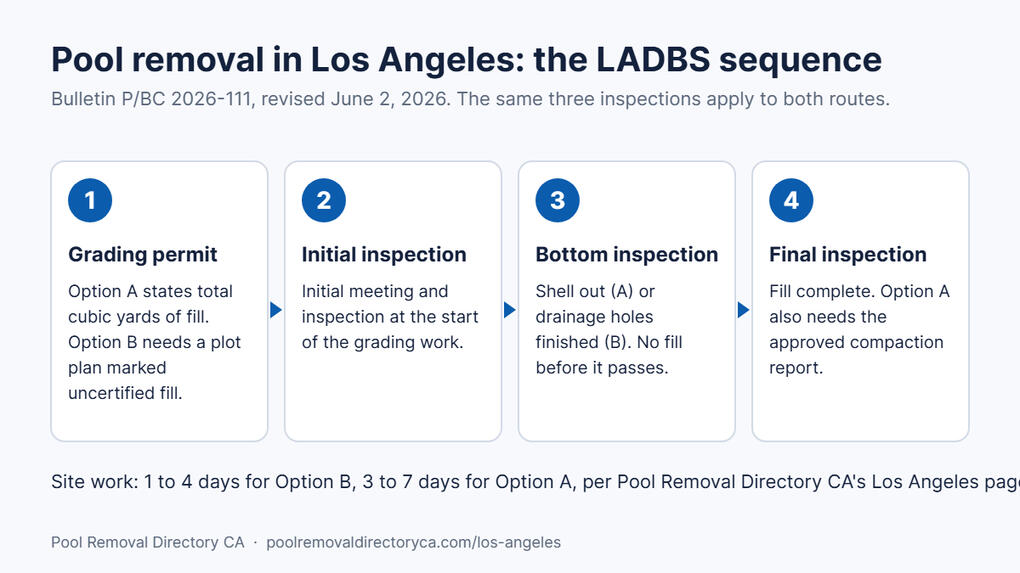
A Los Angeles pool removal moves through four stages: planning, the permit, the site work and the inspections. LADBS, the Los Angeles Department of Building and Safety, controls the permit and all three inspections. The order below follows Bulletin P/BC 2026-111, the LADBS information bulletin on backfilling swimming pools. Bulletin P/BC 2026-111 took effect on January 1, 2026, and LADBS revised it on June 2, 2026. Bulletin P/BC 2026-111 replaced the earlier P/BC 2023-111.Pool removal Los Angeles jobs run in a fixed order: confirm the parcel and the permit office, choose the route, check the contractor's license and obtain the grading permit. The site work follows: the DigAlert call at 811, capping the gas and electric lines, draining the pool and breaking out the shell or the floor. LADBS inspects three times: at the initial meeting, at the bottom before any fill goes in, and at the final inspection.
Before the permit: parcel, route and contractor
Planning decides what the permit file has to contain. Three questions come first, and each one has an official source.Parcel and permit office. ZIMAS, the City of Los Angeles zoning and parcel map, shows whether an address sits inside the city. ZIMAS also shows whether a lot falls inside a Hillside Grading Area. Burbank, Pasadena, Santa Monica, Glendale and Long Beach run their own building departments. A pool in one of those cities goes through that city's office, not LADBS. Unincorporated areas of Los Angeles County follow Los Angeles County Public Works Building and Safety instead. The California Building Standards Commission publishes California's statewide building standards, while the backfill rules here come from the city's own code and bulletin.Route: Option A or Option B. LADBS allows two routes, and both need a grading permit. Option A, full removal, takes the shell off the site and fills the hole with certified compacted fill. Option B, the partial fill-in, leaves the shell in place under Exception No. 1 of Los Angeles Building Code section 7011.3. The filled area under Option B holds uncertified fill and is limited to landscaping. Option B is not allowed where the pool sits on ground steeper than 10%. Option A is the only route for a future ADU, room addition or slab over the old pool.
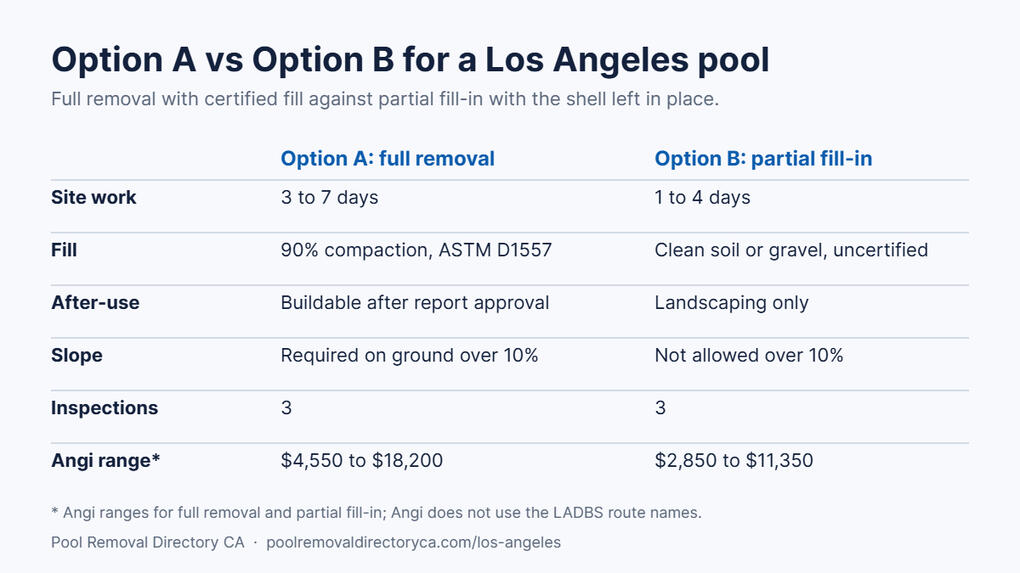
Option A and Option B side by side. The two routes differ on every line that affects the schedule.
Option A site work: 3 to 7 days, per Pool Removal Directory CA's Los Angeles page
Option B site work: 1 to 4 days, per the same page
Option A fill: at least 90% relative compaction under ASTM D1557, tested by an approved agency
Option B fill: clean soil or gravel, uncertified
Option A after-use: buildable once the Grading Division approves the compaction report
Option B after-use: landscaping only while the shell stays buried
Inspections: 3 on both routes
Angi price range: $4,550 to $18,200 for a full removal and $2,850 to $11,350 for a partial fill-in
Option B finishes sooner on site and costs less on Angi's figures. Option A takes longer on site because the whole shell leaves the site, and the Grading Division must approve the compaction report before any foundation work.Contractor license. The Contractors State License Board lookup shows a license's record before any contract is signed. Pool Removal Directory CA lists Los Angeles contractors that were checked against those CSLB records. Owners can run the same CSLB check on any firm that quotes from outside the directory. A license check belongs before any deposit changes hands.
The grading permit and what it must show
LADBS treats pool backfill as grading work, so both routes start with a grading permit. The permit file differs by route.
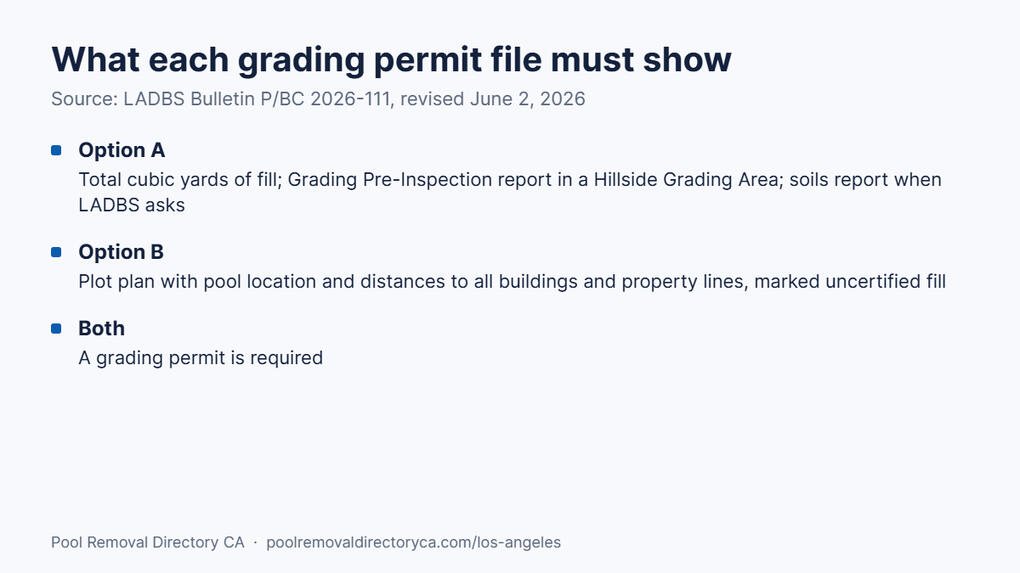
Option A permit file. An Option A grading permit must state the total cubic yards of fill. Bulletin P/BC 2026-111 requires a Grading Pre-Inspection report when an Option A site sits in a Hillside Grading Area. LADBS can also require a soils report from a licensed soils engineer. That soils report covers temporary excavation, grading specifications and allowable bearing pressures for foundation design. Each added report brings an engineer's fee and extra review time.
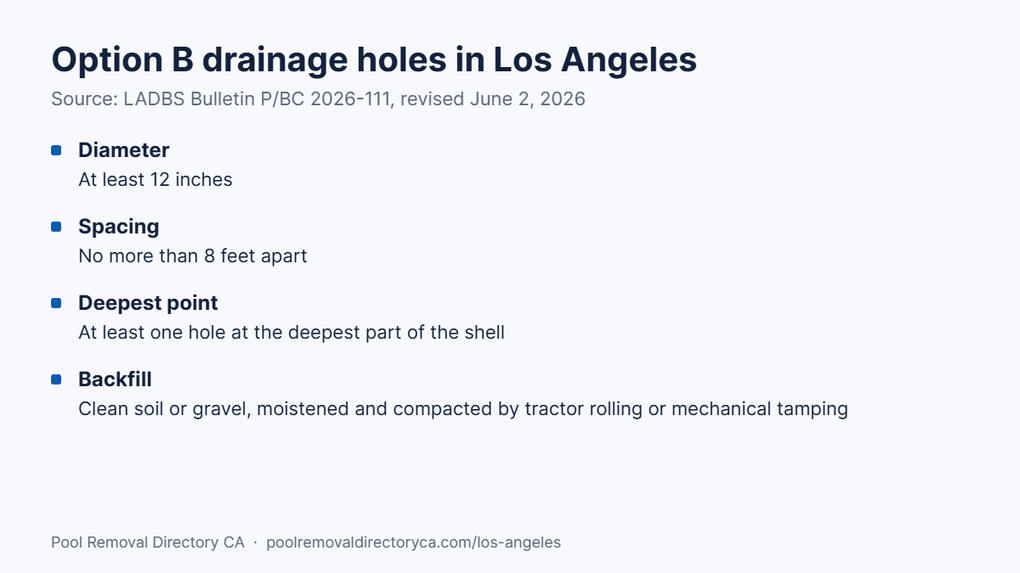
Option B permit file. An Option B grading permit needs a plot plan showing the pool's location and its distances to all buildings and property lines. The plot plan must state clearly that the fill is uncertified. Bulletin P/BC 2026-111 also requires two notes on the plot plan. The first note covers the drainage holes. The second note covers the backfill material. The plot plan notes call for drainage holes at least 12 inches in diameter, holes no more than 8 feet apart, at least one hole at the deepest part of the shell, and backfill of clean soil or gravel, moistened and compacted by tractor rolling or mechanical tamping.Poor drainage lets water collect in the buried basin, which is why the hole rules sit on the plot plan itself.Modification route. Form PC-STR.Mod 44 asks LADBS to let a shell stay with uncertified fill. The request carries a recorded covenant and $255.06 in listed fees. A recorded covenant binds every later owner of the property. The LADBS Grading Division is the office to ask before choosing this path.
On site: utilities, water and demolition
Site work starts only after the permit is issued. Pool Removal Directory CA's Los Angeles page lists site work at 1 to 4 days for a partial fill-in and 3 to 7 days for a full removal.Utilities and buried lines. DigAlert takes the 811 call that has to come before any digging. LADWP handles electrical service to the pool equipment. SoCalGas handles any gas line feeding a pool heater. Gas and electric lines at the equipment pad are capped before the shell is broken.Draining the pool. LA Sanitation and Environment is the City of Los Angeles agency for wastewater and pool discharge rules. Angi lists draining at up to $200 when a professional handles it, or $45 to $80 to rent a pump. Pool water has to leave the site before demolition starts.Demolition and haul-off. Crews on an Option A job break out the entire shell and haul the concrete away. Crews on an Option B job break the floor for the drainage holes and remove the top of the walls. Concrete and rebar from a full removal count as construction and demolition waste. CalRecycle publishes state guidance on recycling construction and demolition materials such as concrete.
The three LADBS inspections
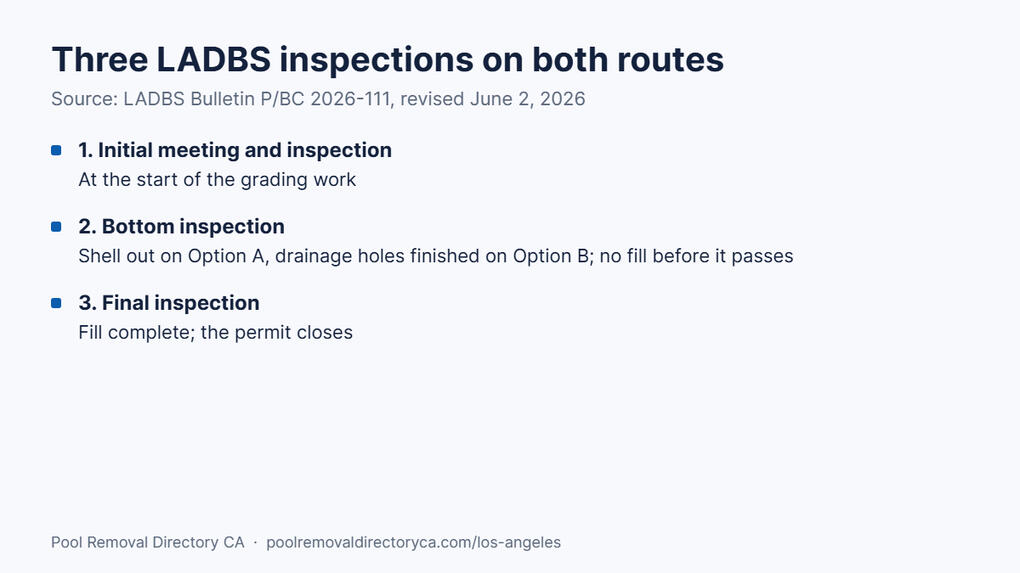
Bulletin P/BC 2026-111 lists the same three inspections for both routes. LADBS must be notified when the grading work is ready for each one.The initial meeting and inspection comes first, at the start of the grading work. The bottom inspection comes next, after the shell is out on Option A or the drainage holes are finished on Option B. The bottom inspection must pass before any fill goes in. The final inspection closes the permit once the fill is complete.
How many inspections does the LADBS grading permit need?
LADBS requires 3 inspections on both routes: the initial meeting, the bottom inspection and the final inspection.
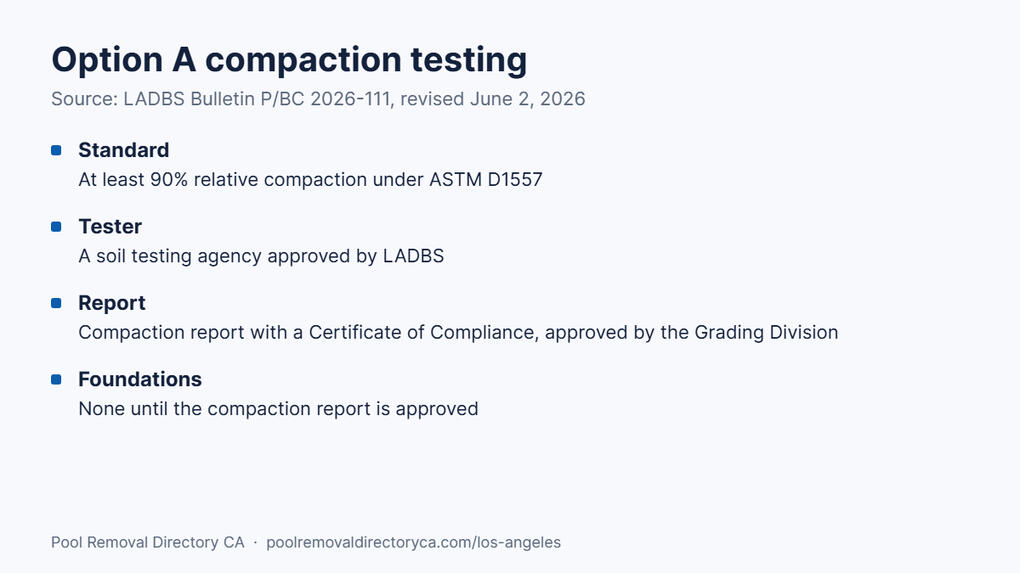
Option A compaction testing. Option A fill sits on natural undisturbed material or approved compacted fill. Option A fill must reach at least 90% relative compaction under ASTM D1557. A soil testing agency approved by LADBS tests the fill. The compaction report, with a Certificate of Compliance, goes to the Grading Division for review and approval.
When can an ADU foundation start over the old pool?
Foundation work can start only after the Grading Division approves the Option A compaction report, under Bulletin P/BC 2026-111 item 7.
Who handles each step
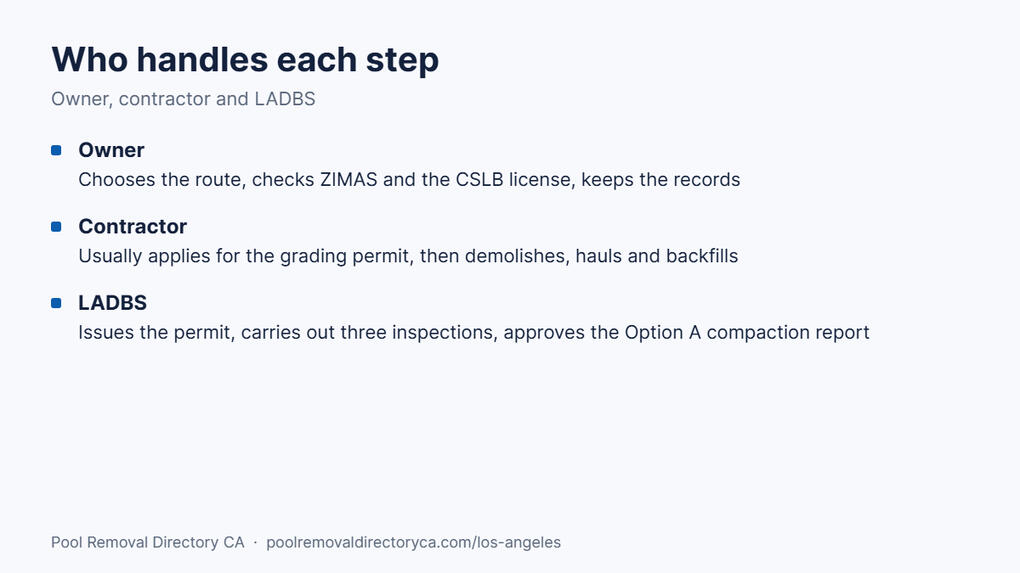
Three parties share the work, and a written contract should say which one owns each task.The owner. The owner decides the route, because only the owner knows whether an ADU, addition or slab may follow. Owners also check the ZIMAS parcel record and the CSLB license before signing. The owner keeps the finaled permit and the compaction report or plot plan once the job closes.The contractor. Contractors in Los Angeles usually apply to LADBS for the grading permit, then demolish, haul and backfill once the permit is issued. The contractor's written quote should confirm who arranges the DigAlert call and the utility capping rather than leave them implied. Contractors also arrange haul-off of concrete and rebar on an Option A job.LADBS. LADBS issues the grading permit, carries out the three inspections and closes the permit at the final inspection. The LADBS Grading Division reviews any soils report and approves the Option A compaction report. LADBS also decides a Form PC-STR.Mod 44 request.
How long does site work take in Los Angeles?
Site work takes 1 to 4 days for Option B and 3 to 7 days for Option A, according to Pool Removal Directory CA's Los Angeles page.
What adds time to the schedule
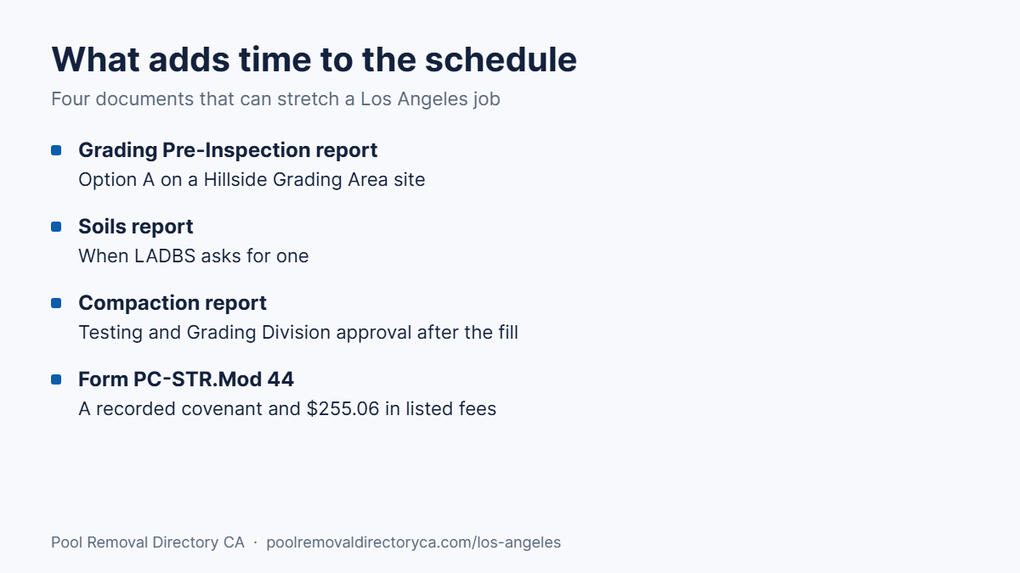
Four documents can stretch a Los Angeles pool removal schedule.
An Option A job on a Hillside Grading Area site needs a Grading Pre-Inspection report.
A soils report, when LADBS asks for one, adds an engineer's review.
Option A compaction testing and the Grading Division's approval follow the fill.
Form PC-STR.Mod 44 adds a covenant to record.
Los Feliz, Mount Washington and the Hollywood Hills are hillside areas of Los Angeles. ZIMAS shows the Hillside Grading Area question before any quote is requested. Owners who check ZIMAS first avoid learning about the report after the contract is signed.
Does a partial fill-in need a permit in Los Angeles?
A partial fill-in needs 1 LADBS grading permit and the same 3 inspections as Option A, and its plot plan must mark the fill as uncertified.Fill does not go in before the bottom inspection. Bulletin P/BC 2026-111 requires the bottom inspection before any fill is placed. The bottom inspection is the scheduled check of the open hole on Option A or the finished drainage holes on Option B.Compacted fill is not certified fill. Option A certified fill means fill tested to at least 90% relative compaction under ASTM D1557, with an approved compaction report. Fill pushed into the hole without testing does not meet that standard, and LADBS allows no foundation over it.The 811 call is not the utility shutoff. DigAlert's 811 call comes before digging, and capping the lines is a separate task. LADWP and SoCalGas handle the electric and gas service that feeds the pool equipment.Other cities use their own building departments. An LADBS permit does not cover a pool in Glendale, Santa Monica or Long Beach. ZIMAS confirms City of Los Angeles jurisdiction before any permit application.
Costs at each stage
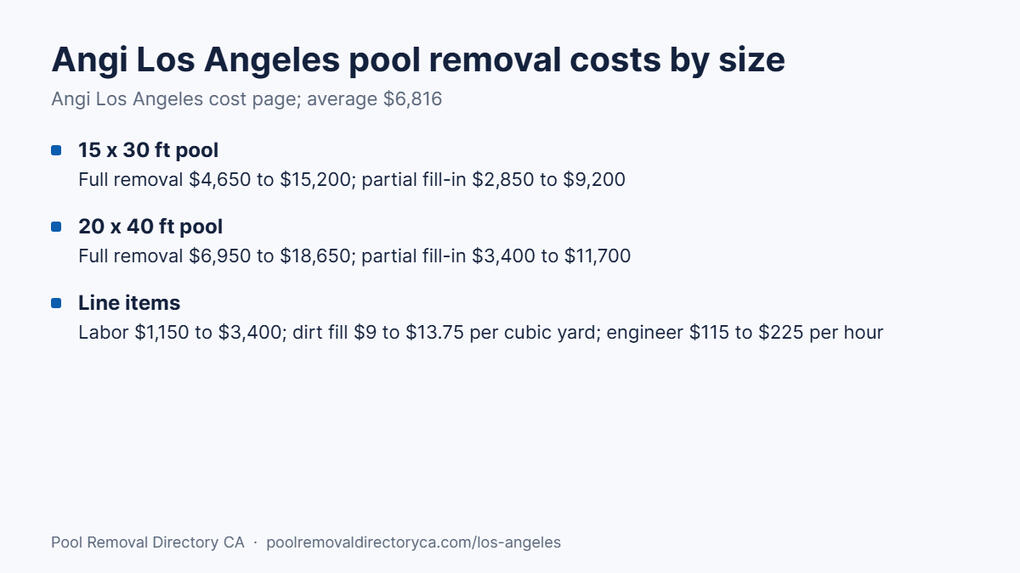
Angi and a local excavation contractor's 2026 guide both publish Los Angeles figures, and the two sources disagree by thousands of dollars.Angi's Los Angeles cost page puts the average pool removal at $6,816, with most projects between $5,680 and $9,088. Angi's full removal range runs from $4,550 to $18,200. Angi's partial fill-in range runs from $2,850 to $11,350. Angi lists labor at $1,150 to $3,400 and dirt fill at $9 to $13.75 per cubic yard. Engineer time runs $115 to $225 per hour on Angi's figures where local code requires an engineer.Pool size moves the Angi figures as well. Angi lists full removal at $4,650 to $15,200 for a 15 x 30 ft pool and $6,950 to $18,650 for a 20 x 40 ft pool. Angi's partial fill-in figures for the same two sizes run $2,850 to $9,200 and $3,400 to $11,700.A local excavation contractor's 2026 guide starts both routes well above Angi's low ends. That guide puts partial fill-in at $8,000 to $18,000. The same guide puts full removal, including engineered, compaction-tested backfill, at $12,000 to $28,000 and up. Full removal commonly runs 30% to 60% above a comparable fill-in, according to that guide. Tight access, oversized decks and long haul routes push totals up.Every written quote should name the route, the permit fee, haul-off, the fill material and cubic yards, and compaction testing for Option A. A quote missing one of those lines is not comparable with a complete one. Pool Removal Directory CA recommends comparing two or more written quotes line by line, because the lowest headline price often leaves out testing or haul-off.
Records, video and contractor lists
A pool removal leaves paperwork that matters at resale, and two further resources help before the job starts.
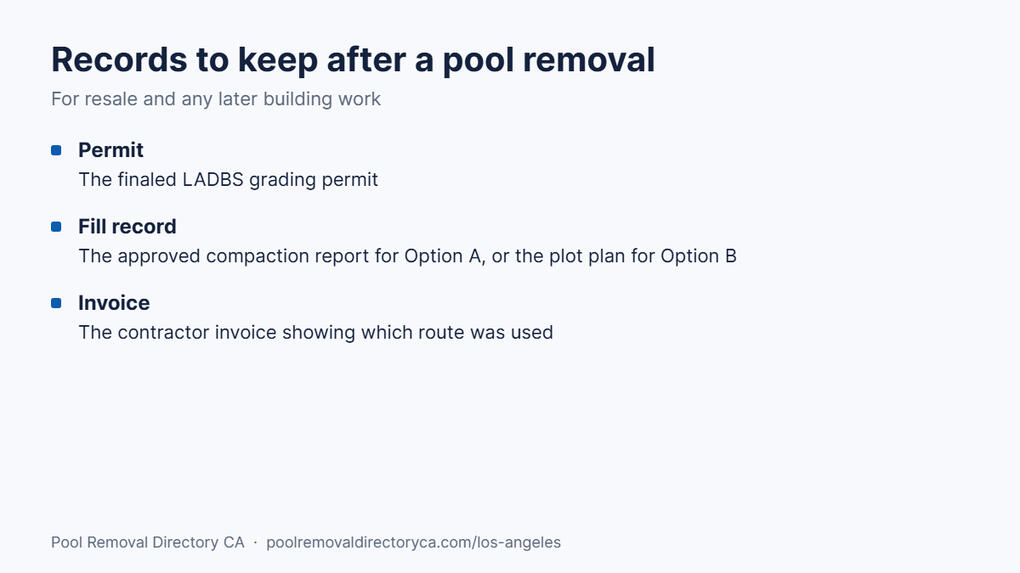
Records to keep at the end. A recorded PC-STR.Mod 44 covenant binds every later owner, so its records matter long after the job. Three documents belong in one folder: the finaled LADBS grading permit, the approved compaction report for Option A or the plot plan for Option B, and the contractor's invoice showing which route was used.Option A owners keep the compaction report because certified fill is what lets an ADU or an addition go over the old pool. Option B owners keep the plot plan because the landscaping-only limit lasts while the shell stays buried.Video walkthrough of the steps. A 3-minute YouTube walkthrough covers the two routes, the LADBS permit and the steps in order.
Where to compare contractors. Pool Removal Directory CA lists Los Angeles pool removal contractors checked against CSLB license records, with the city's permit steps on the same page. The directory takes referral requests for neighborhoods across the City of Los Angeles.Pool Removal Directory CA, 1150 S Olive St, Los Angeles, CA 90015, (213) 325-3273. Pool Removal Directory CA is a referral directory, not a contractor.